
What Does a Body Control Module Do in a Car?
A Body Control Module (BCM) controls and coordinates many of the electrical functions you use throughout the vehicle, including access, lighting, security, and passenger-comfort systems. When you lock a door, lower a window, switch on an interior lamp, or activate the wipers, the BCM may process the request and manage the response. Depending on the vehicle architecture, it can operate lamps, relays, and simple actuators directly, or send commands to local door, lighting, mirror, and comfort modules over the vehicle network.
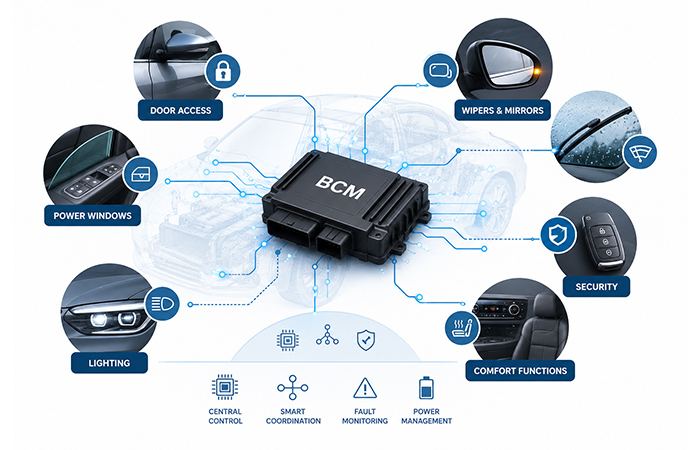
The exact functions vary by vehicle. A BCM may control a load directly or coordinate another local module through the vehicle network.
What Systems Does a Body Control Module Control?
The exact list varies by vehicle, but the BCM commonly manages or coordinates the systems below. When you ask what does the BCM control, the answer usually includes access, windows, lighting, mirrors, wipers, security, comfort functions, power states, and body-system diagnostics. The practical function of the body control module is to connect your requests with the correct vehicle response while considering current vehicle conditions.
| Function group | Typical BCM responsibilities |
|---|---|
| Door access | Locking, unlocking, trunk release, child locks and latch status |
| Power windows | Window commands, one-touch operation, lockout and global closing |
| Lighting | Interior lamps, welcome lighting, turn signals and selected exterior lights |
| Mirrors | Adjustment, folding and heating coordination |
| Wipers and washers | Wipe timing, washer requests and rain-sensor coordination |
| Security | Keyless-entry messages, alarm arming and immobilizer coordination |
| Comfort | Defogging, accessory timers and selected seat or HVAC-related requests |
| Power states | Vehicle wake-up, delayed shutdown, sleep and selected load control |
| Diagnostics | Load faults, switch faults, communication status and warning reporting |
Door Locks, Trunk Release and Access Control
When you press the remote key, touch a keyless-entry handle, or use the lock switch inside the vehicle, the BCM receives the request and checks whether the requested action is appropriate. It may consider door and latch status, vehicle speed, ignition state, child-lock settings, and the current security mode before locking, unlocking, or releasing the trunk.
This allows one module to coordinate central locking, selective driver-door unlocking, automatic locking after the vehicle begins moving, remote trunk release, and warning responses when a door is not fully latched.
Power Windows and Door Functions
The BCM can coordinate window up and down requests, one-touch movement, driver-controlled window lockout, and global opening or closing when you unlock or secure the vehicle. It may also combine window commands with rain detection, vehicle locking, and anti-pinch status supplied by the local motor controller.
In some vehicles, the BCM drives selected power window functions directly; in others, it sends commands to local door modules over LIN or CAN.
This distinction matters because the BCM does not always power the window motor itself. In a distributed vehicle architecture, the local door module handles motor current and anti-pinch control, while the BCM coordinates the requested action with locking, security, and comfort settings.
Interior and Exterior Lighting
When you unlock the vehicle, open a door, activate a turn signal, or leave the car at night, the BCM may coordinate the lighting response that you see. It can manage or supervise courtesy lamps, dome lights, welcome lighting, follow-me-home lighting, turn signals, parking lights, and selected exterior lamps.
The BCM can combine lighting requests with door status, vehicle locking, ignition state, ambient-light information, and programmable timers. This allows the vehicle to illuminate the cabin when you enter, keep selected lamps active after you park, or report a lamp fault to another control unit.
Advanced LED headlamps and matrix-lighting functions are usually handled by dedicated lighting modules, while the BCM coordinates requests, power states, activation timing, and fault information.
Mirrors, Wipers and Washers
The BCM may help coordinate the functions that keep your view clear and make the vehicle easier to use. Depending on the vehicle, it can process commands for mirror adjustment, folding and heating, as well as wiper timing, washer requests, rain-sensor responses, and wiper park status.
For example, locking the vehicle may trigger automatic mirror folding, while a rain-sensor message may request intermittent or continuous wiping. The BCM can combine these requests with ignition state, vehicle speed, current wiper position, and other body-system information before the action is performed.
The BCM may issue the command or coordinate a local door or wiper module. The detailed motor-driving stage is normally handled elsewhere in the vehicle electronics.
Keyless Entry, Alarm and Security Coordination
When you press the remote key or approach a vehicle with passive entry, the BCM may receive or coordinate the request before the doors unlock. It can combine remote unlock, passive-entry information, door and intrusion status, alarm settings, and the current vehicle state to determine the appropriate response.
During an alarm event, the BCM may coordinate hazard-lamp flashing, horn activation, central locking status, and security messages sent across the vehicle network. It may also exchange immobilizer authorization messages with dedicated security modules, gateways, and the engine ECU.
The BCM usually forms part of a larger vehicle-security system. It coordinates access and alarm functions, but key authentication, engine-start authorization, and immobilizer logic may also involve separate control units.
Cabin Comfort and HVAC-Related Functions
The BCM may coordinate several electrical functions that make the cabin more comfortable and convenient for you. These can include the rear-window defogger, heated mirrors, cabin lighting, accessory-power timers, seat-related requests, and selected HVAC-related actions.
For example, when you start the vehicle on a cold morning, the BCM may coordinate heated mirrors and rear defogging based on your request, ignition state, battery condition, and timer settings. It may also keep selected accessories active briefly after you turn off the ignition, giving you time to close a window or use the cabin lights.
In distributed vehicle architectures, the BCM may send seat-related requests or HVAC-related requests to dedicated local modules rather than driving every actuator itself. Small comfort actuators, such as simple air flaps or convenience motors, may also be coordinated through LIN-connected nodes.
A dedicated HVAC controller usually handles full climate-control algorithms, including temperature regulation, compressor control, blower strategy, and complex airflow management. The BCM normally coordinates selected requests, power states, and status information.
Wake-Up, Sleep and Accessory Power
The BCM helps decide when selected body systems should become active and when they can return to a low-power state. Opening a door, pressing the remote key, or operating a switch may trigger a vehicle wake-up request so the systems you need are ready before the engine starts.
After you switch off the ignition, selected accessory circuits may remain active temporarily. This can allow you to close the windows, use the audio system, or keep the cabin illuminated for a defined period. Once the vehicle becomes inactive, the BCM helps coordinate sleep mode across body modules to reduce battery drain.
During low-voltage conditions, the BCM may disable or delay selected comfort loads to preserve energy for essential vehicle functions. The exact strategy depends on the vehicle architecture, battery state, and power-management rules defined by the manufacturer.
Direct Control vs Coordinated Control
The BCM does not physically drive every electrical function in the vehicle. In some cases, a BCM output directly switches a lamp, relay, or simple actuator. In other cases, it sends a command to a local door, lighting, seat, or HVAC module that performs the actual action.
Understanding the difference between direct BCM control and coordinated BCM control helps you see what the body control module really does. It may switch a load, send a network command, validate a status signal, or combine several functions into one vehicle sequence.
| BCM role | What it means | Example |
|---|---|---|
| Direct control | The BCM output directly switches or regulates a vehicle load. | Interior courtesy lamp |
| Coordinated control | The BCM sends a network command to another module that operates the load. | Window-close command sent to a door module |
| Status monitoring | The BCM receives, checks, and validates a signal or module status. | Door-latch or wiper-park status |
| System coordination | The BCM combines several body functions into one coordinated sequence. | Unlocking doors while activating welcome lights |
How the BCM Connects User Requests to Vehicle Actions
When you press a switch, unlock the vehicle, open a door, or activate a body function, the BCM helps connect your request to the correct physical response. It may receive the request directly from a switch or sensor, or receive it as a message from another control unit through the vehicle network.
A practical Body Control Module diagram can be understood as three simple stages: the BCM receives a request, checks the current vehicle conditions, and then either controls a load directly or sends a command to another module.
The BCM receives a switch input, sensor signal, remote-key request, or network message.
It checks vehicle speed, ignition state, door status, security settings, and other operating conditions.
The BCM directly switches a load or sends a command to a door, lighting, seat, or comfort module.
Why Are These Functions Centralized in the BCM?
The main body control module purpose is not simply to turn individual devices on and off. It allows several body functions to share vehicle information, operate in a coordinated way, and respond consistently to the same driver request or vehicle condition.
By centralizing common decisions, the BCM can reduce separate control circuits and unnecessary point-to-point wiring. It can also provide shared wake-up and sleep behavior, combine functions such as locking and welcome lighting, and collect status or fault information in one place. This broader role of the body control module makes body electronics easier to coordinate across the vehicle.
Several functions can respond together to one vehicle event.
Shared logic reduces the need for separate independent controllers.
Network messages replace some point-to-point signal connections.
Body systems can wake up and enter sleep in a controlled sequence.
Faults and body-system status can be shared with other ECUs.
Fault Monitoring and Status Reporting
In addition to controlling body functions, the BCM may monitor whether a request was completed correctly and whether a connected load or signal is behaving as expected. Depending on the available hardware and vehicle architecture, it may detect an open load, short circuit, stuck switch, motor overload, communication loss, or an implausible combination of body-status signals.
An implausible door state, for example, may occur when the vehicle receives conflicting locked, latched, and door-ajar information. The BCM can compare these signals and report that the observed state does not match the expected vehicle condition.
When a fault is detected, the BCM may disable the affected output, store fault information, report the status to another ECU, or trigger a warning for the driver. The exact reaction depends on the function involved, the severity of the fault, and the diagnostic strategy defined for the vehicle.
A BCM response may include:
Does Every Car Use the BCM in the Same Way?
No. The exact body control module functions depend on how the vehicle manufacturer has divided electrical responsibilities across the vehicle. Two cars may both use a BCM, but one BCM may directly switch many lamps and relays while another mainly coordinates local door, lighting, seat, and zone-control modules.
In a centralized architecture, the BCM often receives more switch and sensor inputs and directly controls a larger number of body loads. This approach places more responsibility inside one central unit and can simplify the way shared functions such as locking, lighting, and vehicle wake-up are managed.
In a distributed architecture, local modules perform more of the physical work. A door module may operate the window motor, a seat module may handle seat movement, and a dedicated lighting controller may manage advanced lamps. In this case, the BCM acts more as a body-system coordinator, sending commands and collecting status through LIN or CAN.
Newer zone-based vehicle architectures may use several zone or body controllers positioned around the vehicle. These controllers manage nearby loads and sensors, while a central gateway or computing platform coordinates higher-level vehicle behavior. A vehicle may therefore contain one traditional BCM, several body controllers, or multiple zone controllers with BCM-like responsibilities.
One BCM directly handles more inputs, outputs, relays, lamps, and simple actuators.
Door, seat, lighting, and comfort modules perform local actions while the BCM coordinates them.
Several zone controllers manage nearby loads and share information with central vehicle computers.
What Does the BCM Usually Not Control?
The BCM is important, but it is not the only control unit in your vehicle. It usually focuses on body, access, lighting, comfort, and convenience functions rather than propulsion, traction-battery management, infotainment processing, or complete climate-control algorithms. The exact division still depends on the vehicle architecture.
| Usually handled elsewhere | Typical controller |
|---|---|
| Engine combustion, torque, and emissions | Engine Control Module (ECM) |
| Transmission shifting and hydraulic control | Transmission Control Module (TCM) |
| Traction-battery cells, state of charge, and cell balancing | Battery Management System |
| Adaptive or matrix-headlamp algorithms | Dedicated Lighting Controller |
| Full temperature, blower, compressor, and airflow algorithms | HVAC Controller |
| Media, navigation, connectivity, and display processing | Head Unit or Infotainment Domain Controller |
Summary: Main Body Control Module Functions
The BCM manages or coordinates access, windows, lighting, mirrors, wipers, security, comfort functions, power states, and body-system diagnostics. Its exact responsibilities depend on whether the vehicle uses a centralized, distributed, or zone-based electrical architecture.
The most useful way to understand what a body control module does is to view it as the coordinator that connects your body-function requests with the correct vehicle action, while sharing status, power-state, and fault information with other control units.
FAQs About What a Body Control Module Does
These answers help you understand what a body control module does, which vehicle systems it manages, and when it controls a function directly or coordinates another module.
What does a body control module do? +
A body control module, or BCM, manages and coordinates many body-related electrical functions in a vehicle. These commonly include door locks, power windows, interior and exterior lighting, mirrors, wipers, keyless entry, alarms, comfort functions, power states, and body-system status reporting.
What systems does the BCM control in a car? +
The exact list varies by vehicle, but the BCM commonly manages or coordinates door access, central locking, windows, lighting, mirrors, windshield wipers, washers, security functions, accessory-power timing, selected cabin-comfort requests, wake-up and sleep behavior, and body-system diagnostics.
Does the BCM control door locks? +
Yes. The BCM commonly manages central locking, selective unlocking, automatic locking, trunk release, child-lock settings, and door or latch status. It may also combine lock requests with vehicle speed, ignition state, remote-entry messages, and the current security mode.
Does the BCM control power windows? +
It may. In some vehicles, the BCM directly manages selected window functions. In others, it sends commands to local door modules over LIN or CAN. Typical functions include window up and down requests, one-touch operation, lockout, global closing, and coordination with anti-pinch status.
Does the BCM control headlights and interior lights? +
The BCM commonly controls or coordinates interior lamps, courtesy lights, welcome lighting, follow-me-home lighting, parking lamps, turn signals, and selected exterior lights. Advanced LED or matrix-headlamp algorithms are usually handled by a dedicated lighting controller, while the BCM coordinates requests and status.
Does the BCM control windshield wipers? +
Depending on the vehicle architecture, the BCM may manage or coordinate wiper timing, washer requests, intermittent operation, rain-sensor requests, and wiper-park status. A separate wiper controller or local motor module may perform the actual motor-driving function.
Does the BCM control the alarm and immobilizer? +
The BCM often coordinates keyless entry, alarm arming, door-intrusion status, horn activation, and hazard-light responses. It may also exchange immobilizer authorization messages with keyless-access modules, gateways, and the engine ECU, but it does not always perform the complete authentication process itself.
Does the BCM control air conditioning? +
The BCM may coordinate selected HVAC-related requests, rear-window defogging, heated mirrors, accessory timers, and small comfort actuators. A dedicated HVAC controller usually handles full temperature regulation, compressor operation, blower strategy, and complex airflow control.
Does the BCM directly control every body function? +
No. The BCM may directly switch simple loads such as lamps or relays, but it may also send commands to door, seat, lighting, HVAC, or zone-control modules. It can additionally monitor status signals and combine several body functions into one coordinated sequence.
Why does a vehicle use a BCM instead of separate controllers? +
Centralizing shared body decisions allows different functions to work together. It can reduce separate control circuits and point-to-point wiring, support common wake-up and sleep behavior, and provide one place for body-system status and fault information to be coordinated.
Can a car have more than one body control module? +
Yes. Some vehicles use one centralized BCM, while others distribute body functions across several door, rear-body, comfort, or zone controllers. Newer zone-based architectures may use multiple controllers with BCM-like responsibilities in different parts of the vehicle.
Does the BCM communicate over CAN or LIN? +
Many BCMs communicate over both CAN and LIN. CAN commonly connects the BCM to gateways and other major ECUs, while LIN is often used for lower-cost local modules such as door, mirror, seat, or small comfort nodes. The exact network arrangement depends on the vehicle.
